2025 Ossie Awards: Charlotte Wilkes Wins APC Journalism Student of the Year
By Jeanti St Clair, JERAA Vice-President Awards
December 2, 2025
The 2025 Ossie Award winners, showcasing excellence in journalism produced by students enrolled in university journalism programs in Australia, New Zealand and the South Pacific, were announced at the Journalism Education and Research Association of Australia conference, at Griffith University, Brisbane, on 2 December, 2025.
Links to the stories and judges’ comments are below, where publicly available. Prize awards indicated where applicable.
The Australian Press Council Prize for Journalism Student of the Year ($750)

Winner – Charlotte Wilkes, RMIT University, Body of Work
Charlotte Wilkes’ entry displayed a dedicated commitment to both high standards of journalism and her academic studies. She submitted a substantial and wide-ranging portfolio that highlights the breadth of journalism she undertook while studying. Her well-executed work spans radio, digital and television, with stories airing on AM, Australia Wide and Triple J Hack, as well as reporting for ABC News and Stateline Victoria. Across these pieces, she shows clear news judgement, strong sourcing and an ability to communicate complex or unfamiliar issues with clarity. Her regional reporting – from road safety to meteor fragments – reflects careful journalism and confident storytelling, complemented by digital articles, science pieces, early-morning bulletins and a student podcast. Charlotte’s portfolio shows a journalist with a clear voice and consistent, confident craft across formats, making her a standout winner for the 2025 Australian Press Council Award for Journalism Student of the Year. Our recognition comes swiftly on the heels of the Victorian Rural Press Club naming her the 2025 Ray Frawley Young Journalist of the Year.

Highly Commended – Blair Wise, University of Newcastle, Body of Work
Blair Wise submitted a polished and versatile portfolio spanning print, online, video and multimedia. His campus and social-issue reporting is balanced and well-sourced, while his Newcastle Herald work shows strong regional awareness and public-interest focus. His Shorthand feature on coastal inundation and clear short-form video explainers highlight confident visual storytelling and technical skill. Across formats, Blair demonstrates sound news judgement, accuracy and maturity, marking him as a capable emerging journalist with breadth and clarity in his craft.
Judges: Helen Dalley and Sally Basser (Australian Press Council Members)
Best text-based story by an undergraduate student – over 750 words ($200)
Winner – Cameron Burt, La Trobe University, Footy after knock-off: The grind of state league football
Cam Burt’s exploration of semi-pro AFL players is a fascinating and well-executed look at something few people know about, written with confidence, verve and just the right interviews.
Highly commended – Sabrine Nasri, UNSW Sydney, Vloggers revel in Afghan access as our women’s rights are erased
Combining a personal story with objective reporting is among the most difficult of feature styles, but Sabrine Nasri pulls it off. This is a thought-provoking and balanced piece that nonetheless manages to pack a punch.
Judge: Myriam Robin, Australian Financial Review
Best text-based story by a postgraduate student – over 750 words ($200)
Winner – Tess Nikitenko, Deakin University, Locked Out of the System and Left in the Dark: How Judicial Systems Fail Grieving Families
Tess Nikitenko’s narrative exploration of the despair of the family of Jason Mazurek, who disappeared approaches the issue with sensitivity, allowing the story structure to gracefully reveal what happened. She should be recognised as well for the determination with which her reporting poked through official intransigence.
Highly Commended – Karima Fai’ai, Massey University, Return to Paradise? What it really takes to live Samoa’s way
Karima Fai’ai’s extensively reported piece on the experience of those of Samoan heritage returning to Samoa was ably told, particularly considering its length and complexity, and should be highly commended.
Judge: Myriam Robin, Australian Financial Review
Best text-based story by an undergraduate or postgraduate student – 750 words or less ($200)
Winner – Sophia Grant, RMIT University, Running in Darkness
Sophia Grant’s story tackles a serious and well-known social issue but with a different slant. It literally puts you in the shoes of people who feel vulnerable when they go outside at night (which will hopefully give many men pause for thought) but also points out that it should not be up to women to have to take safety precautions. Great visuals to accompany the story and solid links to necessary data.
Highly Commended – Olivia Goeldner, University of Newcastle, Renting in Newcastle is ‘soul crushing’
Olivia Goeldner’s in-depth take on rental woes in Newcastle is a fresh take on a well-known issue.
Highly Commended – Rachel Forbes, University of South Australia, Should South Australia adopt Western Australia’s Shark Deterrent Rebate?
Rachel Forbes’ South Australian shark mitigation story was extremely well researched, and supported by a moving case study.
Judge: Bruce McKenzie, ABC North Coast
Best audio story (short-form) by an undergraduate or postgraduate student ($200)
Winner – Daniel McLaren-Kennedy, UNSW Sydney, Challenge to ‘moral panic’ of how vapes should be classified
A well-crafted story from Daniel McLaren-Kennedy providing plenty of information while also maintaining the audience’s attention. Excellent use of music. The narrative and questions flowed well, interspersed with relevant, contextual counter arguments. The piece set out to provide an alternative position on conventional health advice around vaping and left the audience with a better understanding of the topic.
Highly commended – Grace Russell, Bond University, Listen here
A sensitive and respectful report largely reliant on a key case study of a female sex worker, looking at the impact of new laws for sex workers in Queensland. The trust built up between the reporter and subject allowed a real insight into the challenges of the work, but also opportunities too. Timely use of news clips.
Highly commended – Alexandra Fairfield-Smith, Bond University, A Split Second
Attention-grabbing audio from the onset set up this very personal story and left the listener wondering what had happened to the young woman. A powerful, intimate account of trauma with appropriate use of music to recreate tension and atmosphere.
Judge: Bronwyn Herbert, ABC News
Best audio story (long-form) by an undergraduate or postgraduate student ($200)
Winner – Hugh Phillips and Genevieve Blandin de Chalain, University of Technology Sydney, Stateless – Myanmar Nationals Now
Stateless – Myanmar Nationals Now combines exceptional field reporting with engaging historical context and confident storytelling. The use of archival footage added light relief and texture to a harrowing subject. At the same time, vivid interviews and skilful production illuminated the human cost of Myanmar’s refugee crisis with empathy, clarity, and editorial maturity.
Highly commended – Brendan Kearns, Ellen Cutler and Yuqi Zhao, The University of Melbourne, Distraction: Tech Overload
Distraction: Tech Overload explores the ethics of the digital age with clarity and creativity. Through tightly produced stories offering innovative and distinct perspectives on the theme, inventive use of b-roll and sound effects, and strong interviews, it delivers an engaging, balanced, and highly relevant piece of audio journalism.
Judge: Sasha Borissenko, Freelance journalist, #AccessMediaNZ national representative
Best video story (short-form) by an undergraduate or postgraduate student ($200)
Winner – Brendan Kearns, The University of Melbourne, It’s not your average share house. But it is a win-win for differently abled housemates
Brendan Kearns’ piece successfully employees the tools of the platform – audio upsots and shot sequences – to tell a unique story. The time Brendan has spent building rapport with the interviewees is apparent and allows for compelling insight into the experiences of the interviewees.
Highly commended – Hanwen Wang, Monash University, Single Father
Hanwen Wang’s piece features a great variety of framing and sequencing to offer the viewer a seat at the table as he tells a very personal story. This piece is well-executed and would be at home in the long form category.
Judge: Nicole Hegarty, Federal Political Reporter, ABC News
Best video story (long-form) by an undergraduate or postgraduate student ($200)
Winner – Steven Willem, UNSW Sydney, Going Wild
Steven Willem’s longform documentary Going Wild combines excellent filming, atmospheric sound and music to take the viewer on a journey alongside Caroline as she develops a love of long-distance hiking. The use of GoPro and talent-led storytelling keeps the audience onboard with the physically and mentally exhausting feat.
Highly commended – Madigan Landry, Curtin University, The Long Road Home
Madigan Landry’s The Long Road Home tells a compelling story about the closure of the indigenous settlement of Oombulgurri in The Kimberley and its enduring impact on its residents, led by the interviewees and complemented by original and archive footage and photos.
Judge: Nicole Hegarty, Federal Political Reporter, ABC News
John Newfong Award for Reporting on Indigenous Affairs – (Individual, Undergraduate or Postgraduate, Any Medium) ($200)
Winner – Aisha Campbell, Auckland University of Technology, Whakatairanga ka tika, whakamaua ngaa mita
Aisha Campbell ‘s report reveals an innovative approach to preserving te reo Māori through AI, combining technological advancement with deep cultural significance. By centering Dr Te Taka Keegan and Te Kōpae Piripono, it delivers personal insight alongside expert commentary, demonstrating the real-world impact of revitalising language. Its interactive, technology-driven storytelling showcases how the future of journalism can engage readers while situating these initiatives within broader social and historical contexts.
Highly Commended – Lilas-Mae Njoo, University of Technology Sydney, Risk to Indigenous languages without more funding
Lilas-Mae Njoo’s article excels in combining statistical context, expert insight, and compelling storytelling to highlight the urgent need for investment in Indigenous language preservation. The article personalises the issue while connecting it to global examples, making the stakes clear and immediate. The reporting balances policy, community impact, and cultural significance, demonstrating the power of journalism to inform and inspire action.
Judge: Bronte Charles, Journalist, NITV/SBS
Best Data Journalism by an Undergraduate or Postgraduate Student (individual or group)($200)
Winner – Caitlin Maloney, University of Technology Sydney, ‘Shocking’ drop in aged care COVID vaccinations
Caitlin Maloney’s data journalism story establishes a clear and relevant data-led context for a shocking mismanagement of COVID in aged care. Her narrative logically guides the reader through complex statistics with clarity. The integration of original graphics and balanced testimony of facility managers to personalise this story and demonstrates excellent editorial judgement.
Highly recommended – Madigan Landry, Kimberley Putland, Camila Egusquiza Santa Cruz, Yousuf Shameel, Curtin University, Owls on Deathwatch
A robust and thorough piece on the impact of rodenticides on owls that effectively combines original data collection with strong human case studies, such as Poppy Mahon’s campaign, to highlight regulatory failure.
Judge: Miguel D’Souza, Journalist, Trainer, Google Teaching Fellow 2020-2022
Best Visual Journalism by an Undergraduate or Postgraduate Student (all media, individual or group) ($200)
Winner – Meghan Andrea Fernandes, The University of Melbourne, Between Worlds
Meghan Andrea Fernandes successfully incorporates visual elements and effects to compliment her written story, Between Worlds, and create further audience insight into the experience of international students. The easy-to-understand graphs break down dense numbers, while the carefully selected photos illustrate the emotion of the story. Well done on this thought-provoking storytelling!
Highly commended – Anthony Vigliante, UNSW Sydney, ‘In my own time’: Returning choice to those living with dementia
Anthony Vigliante’s story demonstrates a new and innovative way to visually tell a story. The virtual reality experience allows the audience to immerse themselves in a story that is deeply personal, thus further strengthening it.
Judge: Amal Wehbe, ABC News, Vertical Video Specialist
Best publication (GBP100 book voucher, sponsored by Intellect Books)
Winner – Toby McGee (Supervising Producer), The Struggle, Channel 31, Monash University
The Struggle‘s production was impressive, and the use of silly humour to makes news and current affairs accessible and enjoyable, especially for younger audiences who are increasingly turning away from news. Since the axing of Channel Ten’s The Project, there are few programs who could today be described as “doing news differently” and The Struggle fills that niche.
Highly commended – 2025 MOJO News Federal Election: Australia Decides, Monash University
Mojo’s election special, produced by a team 30+ students, was a very impressive package of live commentary, vox pops and pre-filmed packages. It would have been an immense amount of work and came together beautifully. Commentator Vas Shipp was as good as any you would see on the ABC.
Judge: Alexandra Hansen, Deputy Editor and Chief-of-Staff, The Conversation

The Getty Images Award for Best Photojournalism (Single image) by an undergraduate or postgraduate student ($200)
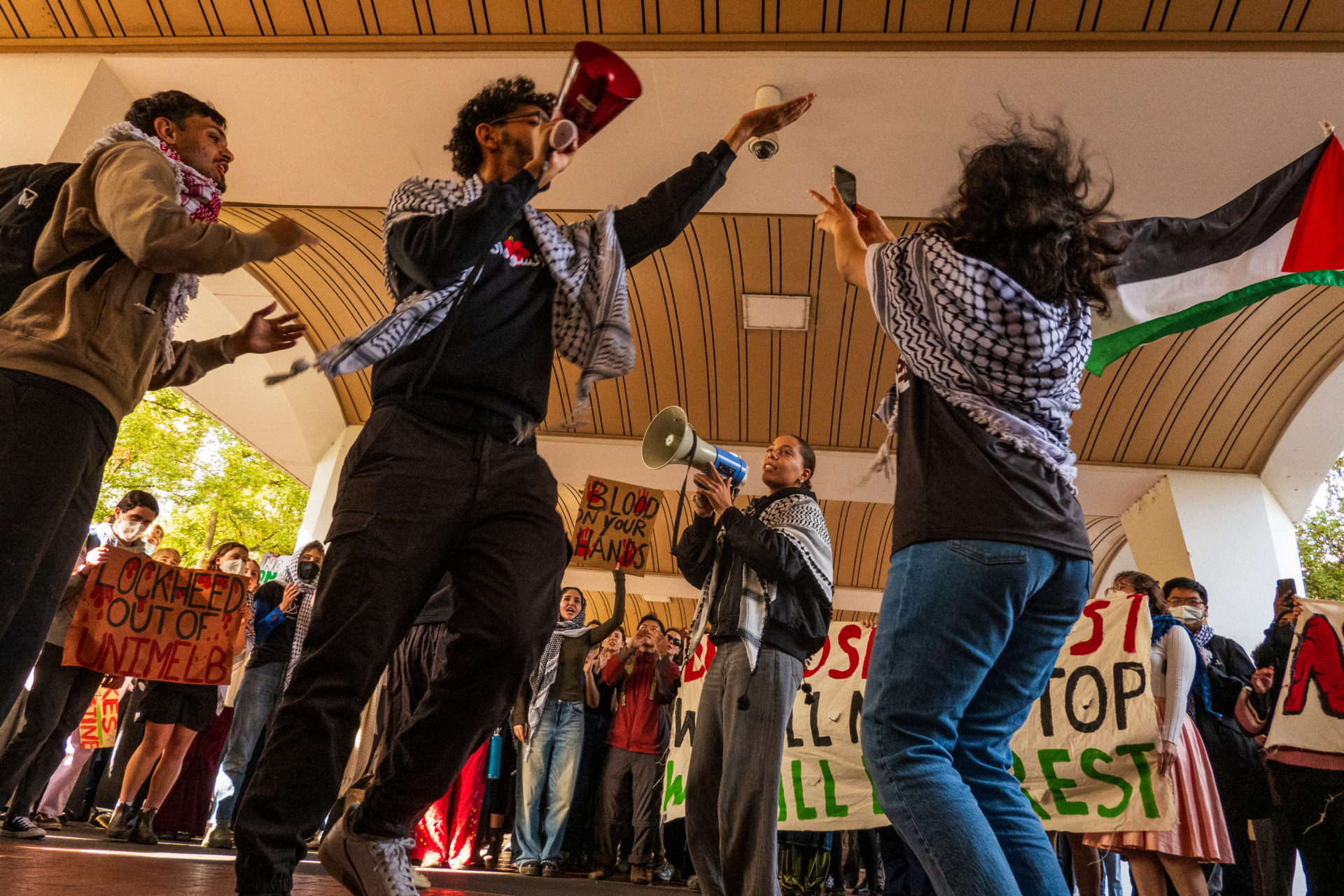
Winner – Chancy Quan, The University of Melbourne, Campus Encampment
Chancy Quan’s photograph of an on-campus protest, Campus Encampment, stood out due to its strong and well-framed composition. The composition uses depth, layers and dimensions to place each element in a balanced and eye-leading way, allowing the viewer to move around the image finding new points of interest that continue to communicate information of the story. The image represents a good reportage style and was a timely and newsworthy story.
Judge: Chris McGrath, Getty Images
The Getty Images Award for Best Photojournalism (Photo essay) by an undergraduate or postgraduate student ($200)

Winner – Lexie Fenner, University of Technology Sydney, 100 Year Index
Lexie Fenner’s photo essay 100 Year Index is a strong character study and a unique subject. A quiet story that intrigues the viewer and holds their attention through good use of compositions, details, depth of field and use of light. The images flowed nicely together giving the story a well-rounded start, finish and middle. The images show intimacy that helps to inform the viewer with each image.
Judge: Chris McGrath, Getty Images
The Private Media Award for Diversity for a student from an underrepresented group ($200)
Winner – Madeline Toth, Murdoch University, Out of the closet and on to the dance floor: Perth’s emerging queer nightlife scene
Madeline Toth’s submission combined strong storytelling with rich and compelling visuals. Her exploration of how Queer nightlife and creative spaces have developed was coherent and interesting. The medium chosen for this news package also complemented the subject matter nicely. This could have been an ambling ‘everything and the kitchen sink’ endeavour, but I found Madeline’s approach refreshingly restrained and clear in its objective. An excellent presentation.
Highly commended – Amar Mustafa, Monash University, The art of (re)making a community in Melbourne
This submission brought an esoteric concept to life, with a noble mission to show how young Australians are expressing hybrid identities, creating their own spaces and finding belonging. I commend the author’s confident choice to explore an interesting subject and his out-of-the-box thinking. Well done.
Judge: Melissa Coade, Senior Journalist, The Mandarin
The Crikey Award for Investigative Journalism by an undergraduate or postgraduate student (individual, any medium) ($200)
Winner – Molly Inglis, RMIT University, Illegal tanning nasal sprays pushed by social media influencers
A cleanly written and perfectly structured expose of a growing and potentially dangerous industry. Molly wrangles the legal and scientific content into clear, digestible sections as well as revealing businesses breaking the law. The use of video as well as text added colour and texture to the story telling.
Highly Commended – Katherine Everest, The University of Melbourne, Foiled again: critics condemn FOI delays as ‘political interference’
A hugely important issue that doesn’t get the widespread attention it deserves, Katherine Everest did a great job illustrating the issue through clearly presented stats and data, and vivid case studies.
Judge: Charlie Lewis, Crikey
The Dorkin Award for Investigative Journalism by an undergraduate or postgraduate student (group) ($200)
Winner – Caitlin Maloney, Charlotte Laidlaw and Abbey Mitchell, University of Technology Sydney, Are women being needlessly prescribed the pill?
A well-written, compelling and unambiguous investigative report that drew you in straight away. Highly informative and clear in its purpose. Additionally, given the limited information, Caitlin Maloney, Charlotte Laidlaw and Abbey Mitchell generated their own survey and garnered 80 respondents.
Judge: Alison Sandy, Seven Network
Mindframe (individual, any medium) for Reporting on a mental health or suicide related issue responsibly, accurately, and sensitively ($200)
Winner – Tayler Mutton, University of Canterbury, Anorexia nearly took my life: Why urgent action is needed
Tayler’s piece compassionately and sensitively explores their lived experience with an eating disorder, providing an opportunity to raise awareness and normalise conversations about mental health and wellbeing. The article strikes a careful balance between encouraging help‑seeking behaviour and advocating for expanded treatment options and uses images and language in a careful, respectful and considered way.
Judges: Helen Le Gresley and Adam Fletcher, Mindframe
Monash Climate Change Communication Research Hub Prize for best climate change reporting ($200)
Winner – Bridget Ross, University of Technology Sydney, The Rubbish Artist
Bridget Ross’ elegant writing paired with her choice of protagonist renders our everyday waste unexpectedly intriguing and sexy. The story blends a compelling narrative with striking imagery and a clear orientation towards practical solutions for consumers, without the climate message feeling overt.
Judge: Amelia Pearson, Monash Climate Change Communication Research Hub
Cait McMahon OAM Journalism and Trauma Reporting Award ($200)
Winner – Christine Lee, University of Technology Sydney, Amy moved 50 times in three years
Christine Lee’s story powerfully illuminates an urgent national issue with compassion and depth. With lived experience, expert analysis and national data, Christine balances trauma, empathy and dignity. It is a moving, accurate piece that advances public understanding of violence, displacement and community impact for an often-hidden face of our society.
Highly Commended – Jayde Andrews, Curtin University, Why didn’t Oma tell me about the war?
Jayde Andrews’ story uncovers the enduring impact of wartime trauma through one family’s hidden history with dignity and deep reflection. By weaving personal memory, historical context and expert insight, Jayde honours her Oma’s experience, while balancing subjectiveness and objectiveness perfectly, and invites readers to understand how silence and survival shape generations.
Judge: Caroline Winter – PodTalk, TV and podcast producer
Our Watch (individual, any medium) for a story which represents best-practice reporting of violence against women and non-binary people ($200)
Winner – Claudia Goundar, The University of Melbourne, ‘For Too Long, Women Have Been Shouldering the Responsibility’: Sexual Harassment Remains Rife in Melbourne’s Live Music Scene
Claudia Goundar’s article empowers her subject and accurately identifies the attitudes that lead to sexual violence, always keeping the perpetrators clearly in view. She makes deft use of national statistics and expert voices to frame the story, placing her subject’s experience within a broader social context. Furthermore, it is concise and compelling. Bravo.
Judges: Drew Ambrose, Al Jazeera, and Amber Cunneen, Foreign Editor, Nine
The Australian Press Council Undergraduate Prize for an essay on media ethics ($200)
Winner – Sienna Pietrosante, Monash University, How does ABC News report on the impact of AI in journalism between February and June 2024?
Sienna Pietrosante’s essay offers a strong, insightful and thoughtful look at a major issue that continues to both perplex, concern but also excite the community, and is particularly key to the media: AI. Sienna’s essay provides clear analysis of the ethics of ABC reporting on AI, showing how the coverage leans toward risk and mistrust while paying limited attention to constructive responses and opportunities. Using well-chosen examples and an ethical focus, she presents a coherent argument about why this framing matters for public understanding.
Judges: Helen Dalley and Sally Basser (Australian Press Council Members)
The Australian Press Council Postgraduate Prize for an essay on media ethics ($200)
Not awarded in 2025.
Judges: Helen Dalley and Sally Basser (Australian Press Council Members)